Showing posts with label Research. Show all posts

Thursday, August 9, 2007

Big Near-Term and Sick Newborns are the Majority of the NICU Admissions

Even though people associate the (NICU) Neonatal Intensive Care Unit with premature babies, near-term babies, the fact is that those babies who are closer to term (40 weeks) are often the ones most frequently admitted.

We get this all the time when I mention my daughter was in the NICU. "Oh, she was a preemie?" "No. She was a Sick Newborn."

Definitions
Near-term infant - a newborn closer to term (40 weeks), often between 34 and 36 weeks or born roughly four or five weeks before his or her estimated due date.

Late preterm infant - Near-term infant

Premature baby - a newborn born before 34 weeks

Sick Newborn - Newborns that are near term or term infants who require Intensive Care intervention for a variety of problems or diseases.
Some near-term or sick newborns experience complications from oxygen deprivation during delivery or wet lungs after a Cesarean section.

Big NICU Babies

According to an article on near-term babies, Dr. Kenneth Herrman, neonatologist and medical director of newborn services at Deaconess Women's Hospital at Riley Hospital for Children in Evansville, IL:
The big babies, closer to term, are the majority, and they stay for the shortest amount of time.

If you would walk through the nursery on any particular day, you would have the impression the NICU is filled with premature babies because they stay a disproportionately longer amount of time.
Our daughter was not a preemie, she was a sick newborn diagnosed with PPHN, or Persistent Pulmonary Hypertension of the Newborn. She required supportive ventilation on a respirator because of high pressure in the lungs and ended up in the NICU.

Combing the Internet for Resources on Sick Newborns
It took me several days after our daughter was hospitalize in the NICU to find online resources for parents of sick newborns since most of the online resources, organizations and online groups are for parents of preemies. This was extremely frustrating for someone used to finding information quickly online.

Thankfully I stumble upon the helpful resources about Sick Newborns written by neonatologist, Dr. Jane E. Brazy and her colleagues at the University of Wisconsin. Over the years, these resources for Sick Newborns are ones that I continue to refer to for my NICU articles. The excellent resources are now being hosted by Meriter Health Services.

Sources
Keeling L. Near-term babies at the NICU suffer from deceptive weakness. June 11, 2007. Evansville Courier & Press.
Rubin R. 'Near-term' unease grows. USA Today. October 9, 2005.
Brazy JE. et. al. Sick Newborn Health. Meriter Health Services.

Image:
Matt & Janet Dustin. All her machines at the NICU. Creative Commons License.

Thursday, July 12, 2007

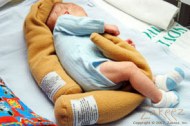
Leave a Zaky hand with Your NICU Baby - Providing Comfort When You are Not There

I think one of the most difficult things for NICU parents to do is to realize that they cannot stay with their NICU baby 24/7 and at some time you have to leave the hospital and your precious baby behind.

I discovered a wonderful product designed by a former NICU Parent that helps provide support and comfort to a NICU baby while you are not there -
The Zaky®.

This product is an answer to the questions "What can I do to support my NICU baby?" I know we would have gotten one for our daughter had they been around at the time.

About the
The Zaky®
The Zaky® was designed by a NICU parent, Yamile Jackson, who has a PhD in ergonomics & human factors engineering after her own NICU experience with her son Zachary in 2001.

The award-winning ergonomic, bonding, therapeutic positioning pillow was designed
especially for premature babies that have to be left at the hospital away from their parents.

The special hand allows you to "leave a hand with a loved one" and "give your baby a hand" when you are not there.

By mimicking the shape, weight and touch of a human hand, the Zaky
® provides comfort to NICU babies (and others) giving support and a sense of security. In the NICU setting, the Zaky® can be another helpful hand assisting with positioning.

Providing Comfort When You are Not There
Here is a list of some of the comforting benefits provided by this
ergonomic, bonding, therapeutic positioning pillow.
  • The size and weight simulates the hand and touch of the mother.
  • It may be used on top, around and under the baby to provide boundaries (except on the face).
  • Babies feel reassured as if someone is touching them, which assists in their need of feeling protected.
  • It assists nurses and care givers as she can leave a Zaky® with each baby.
  • Parents feel as they are leaving one hand with their baby, helping them feel more involved in the care of the patient.
  • May be warmed in the towel warmer at hospitals and on the dryer at home.
In addition the Zaky® can be scented with the scent of mom, dad, or siblings. Scenting the Zaky® can provide a great deal of comfort and assist the baby's transitions to different environments in the hospital, in the car or once at home. The Zaky® is something constant and helps to reduce the shock many baby's experience with different lighting, scents, sounds, temperature, etc.

Uses - NICU and Others
The Zaky
® has been used by mothers, fathers and family members, neonatologists, pediatricians, surgeons, obgyns, nurses, physical & occupational therapists, infant massage therapists, developmental specialists & ergonomists. It has been used in NICUs since 2001 and in homes and child care facilities since 2004.

In addition to being used in the NICU setting, the Zaky
® is also being used to provide comfort in other settings:
  • In hospitals for children and adults that have long hospital stays due to cancer, burn treatments and others.
  • In child care centers and at home for children to use as a comforting security item.
  • In hospitals to help position patients after surgical procedures.
  • In nursing homes to provide comfort and a sense of security to seniors.
Oboz Program - Donate a Zaky® to Your NICU
This is a great idea. The Zakeez company has already
donated over 2,000 Zakys to NICUs worldwide to help their sickest children. They donate the Zaky® to the hospital that you specify and all you have to do is pay for minimal administration fees, shipping and handling. You can donate a Zaky® to your NICU for $7.98.

More about the Oboz Program: http://www.zakeez.com/en/our_company/oboz_program.php

Research
The Zaky® has been presented at several conferences on"Human Hand Mimetic Comforts High Risk Neonates" and "The benefits of the Zaky for mothers, babies, and medical personnel." http://www.zakeez.com/en/our_company/research.php


Ordering Information for NICU Parents:
I have included the prices when the blog was posted. The Zaky comes as a right hand or as a left hand.
From the Zaky site - Is there a difference between the Right and the Left Hand?
  • There appears to be no difference for the baby.
  • Right and left hands are offered because it looks more natural to have one of each if they are use on the same baby.
  • Some parents have preferences--if they are right handed, they want a right Zaky, if they use their left handed, they want a left hand.
  • Many parents choose to get the Zaky in the hand that they use the most to provide comfort for their baby, which may not always be their dominant hand.

More Sources:

Premature Benefits: http://thezaky.com/en/zaky/premature_benefits.php
Research:
http://www.zakeez.com/en/our_company/research.php
Zaky Movie: http://thezaky.com/en/zaky/zaky_jjmovie.php

Photo Source:
Zakeez

Add to Technorati Favorites

Tuesday, July 10, 2007

What can I *do* when a NICU baby dies?

The death of the fourth sextuplet prompted the Blog entry on "What can I *say* when a NICU baby dies?" This entry included several helpful suggestions for what you can say.

This blog is a follow up to the
"What can I *say*" entry with helpful suggestions for "What you can *do*."

What can I *do* when a NICU baby dies?
Two very helpful things you can *do* to support a NICU parent who has lost a baby are to listen and to simply be.

Listening Helps
According to research, doctors on the average interrupt 20 seconds after their patient begins to speak. With the hurried pace everyone seems to be keeping these days, I would think that people often interrupt each other at close to a similar rate. For someone trying to tell their NICU story of loss, listening can be a true gift.

One of the most important things you can *do* for a grieving NICU parent is to give him or her your presence. The ability to listen can be a great source of comfort. Listening communicates respect, caring and empathy. Sometimes all a parent may needs is someone who will truly and emphatically listen to the story of grief. Really listening involves being present for the person, not interrupting and staying connected and focused on what he or she is saying.

Sitting with a NICU parent, listening to the NICU story, being a witness to the pain and sorrow can help provide invaluable support during times of duress.
Spending a few quiet moments in silent contemplation, holding a hand is another effective way to convey your sympathy and support.

Advice on How to Listen
There are several different versions of this inspirational poem on listening. I have pulled one that I thought had the best message and referenced the others under Resources.

There are also several short articles in the references on characteristics of good listening and listening tips from a communication studies course, if you need to practice your attentive listener skills.

Listen

When I ask you to listen to me, and you start giving me advice,
You have not done what I asked.

When I ask that you listen to me, and you begin to tell me why I shouldn't feel that way,
You are trampling on my feelings.

When I ask you to listen to me, and you feel you have to do something to solve my problems,
You have failed me, strange as that may seem.

Listen.
All that I ask is that you listen,
Not talk or do - just hear me.

When you do something for me
That I need to do for myself,
You contribute to my fear and feelings of inadequacy.

But when you accept as a simple fact
That I do feel what I feel, no matter how irrational,
Then I can quit trying to convince you
And go about the business
Of understanding what's behind my feelings.

So, please listen and just hear me
And, if you want to talk,
Wait a minute for your turn - and I'll listen to you.

Source: Author Unknown. Listen. Westhartford Counseling Center.
http://westhartfordcounselingcenter.com/listen.htm


Just Be
Another helpful resource to share with a friend who is hurting, is your presence and your full attention.

Be yourself and relate person to person.
Be ready to listen again and again.
Be respectful.
Be aware of feelings and non-verbal cues.
Be present.
Be comfortable with silence.
Be human.
Be genuine.
Most of all--Be there.
© Kirsti A. Dyer, MD, MS

Remember that two of the greatest gifts you can give to a NICU parent are the gift of listening and the gift of your presence.

Do not underestimate the healing presence yourself and of really listening to someone who is going through a difficult experience.


Other Resources:
Chadwick. N. Please Listen. http://www.1stholistic.com/prayer/hol_prayer_please-listen.htm
Nickerson LS. 2007. Characteristics of Good Listening. Listening and Understanding: Communication Studies. University of Idaho. http://www.webpages.uidaho.edu/~lnicker/page28.html
Nickerson LS.
2007. Listening Tips. Listening and Understanding. Communication Studies. University of Idaho. http://www.webpages.uidaho.edu/~lnicker/page28.html
Author Unknown. Please Listen to Me. Communication Studies. University of Idaho.
http://www.webpages.uidaho.edu/~lnicker/page29.html

Sources:

CBS Broadcasting Inc. June 25, 2007. 4th Sextuplet Born To Minn. Couple Dies. Available at: http://wcco.com/topstories/local_story_176160040.html
Dyer KA. What can I *say* when a NICU baby dies?. June 2007. Available at: http://nicuparentsupport.blogspot.com/2007/06/what-can-i-say-when-nicu-baby-dies.html
Dyer KA. Comforting Moment - It's Only Words... June 2007. Available at:

http://nicuparentsupport.blogspot.com/2007/06/611-comforting-moment-its-only-words.html
Dyer KA. Identifying, Understanding, and Working with Grieving Parents in the NICU, Part II: Strategies. Neonatal Network. June/July 2005; 24: 27-40.
Quill TE. Arnold RM. Platt F. "I Wish Things Were Different": Expressing Wishes in Response to Loss, Futility, and Unrealistic Hopes. Ann Intern Med, Oct 2001; 135: 551-5. Available at: http://www.annals.org/cgi/content/full/135/7/551

Add to Technorati Favorites

Monday, July 2, 2007

NICU from the Nurse's Perspective - When Everything Changes in an Instant

Before the Wave CrashesThis is how it is [in the NICU]...
Everything changes in an instant.

Joni McGovern

12 year NICU Nurse
UCSF's Intensive Care Nursery


This quote sums up life for the NICU Nurse and for the NICU Parent...how one minute you are going along with a normal pregnancy and the next you are in the NICU.

NICU Nurses - Providing Special Care
Chris Colin, author of the On the Job series published for the San Francisco Chronicle, emailed me about an article he had published today. It is a profile on the life of several NICU nurses from UCSF's ICN (Intensive Care Nursery) - located at the very top of the hospital on the legendary 15th floor, home to 50 tiny beds.


As any NICU Parent can tell you, NICU nurses are a very special 'breed' of nurses. We discovered this to be true in our daughter's case. To quote the article,
A [NICU] nurse can fight desperately to save the most fragile human life, and indeed do so for the time being, but turn right around and understand that resuscitation might not be the right decision when the next crisis comes.
It takes a very special medical professional to understand that "resuscitation might not be the right decision when the next crisis comes."

Understanding that Saving a Life isn't always the Best Option

Quality of life was a big issue that I dealt with as a physician caring for older patients with chronic illness, for hospice patients and for those at the end of life. Quality of life is now a major ethical dilemma in the NICU at the beginning of life.

The number of premature births has increased along with the technology to keep younger and younger babies alive. Another of the NICU nurses, interviewed noted:

Some babies aren't meant to live, and it's ultimately a good thing that they don't.
Melitta Hernandez
8 year NICU Nurse
UCSF's Intensive Care Nursery

The ethical dilemma facing neonatology (study of newborns) is that with the technology and the increased number of babies surviving the first few months means there are more children now facing "a lifetime of disability, stunted development or other health issues." So there are times when in the NICU "resuscitation might not be the right decision..." Of course these words may not be comforting to the NICU parents of the tiny premature child.

I don't know if anyone knows the right answer to this unhappy dilemma. Obviously much depends on your perspective...if you are the NICU parent or the CEO of a health care company providing medical insurance.

More Readings:
Carter BS. 2006. Ethical Issues in Neonatal Care. eMedicine. http://www.emedicine.com/PED/topic2767.htm

Source:
Colin C. ON THE JOB: Saving babies: It's not a TV show but these nurses' jobs actually are life-or-death. SF Gate. July 2, 2007. Available at: http://www.sfgate.com/cgi-bin/article.cgi?f=/g/a/2007/07/02/onthejob.DTL

Photo Source:
Kumar Murukan. Just before. Royalty Free Use.

Add to Technorati Favorites

Saturday, June 30, 2007

New Findings on Preterm Labor Meds: Mothers Receiving Magnesium Sulfate More Likely to have NICU Babies

IV Drip

A recent study due to be published in July’s "Green Journal" (Obstetrics & Gynecology Journal) found that newborns whose mothers had received magnesium sulfate were more likely to be admitted to the NICU than those whose mothers had received the alternative treatment (nifedipine). At this point, the researchers cautioned that the data did not offer a clear explanation for this finding and more research needs to be done to rule out other causes.

Deirdre Lyell, MD, a specialist in high-risk obstetrics at the Lucile S. Packard Children’s Hospital at Stanford, CA led the investigations that compared the use of magnesium sulfate with nifedipine for acute tocolysis of preterm labor.

Definitions

  • Preterm labor – labor before 37 weeks of gestation (completed weeks of pregnancy).
  • Preterm birth – a baby born before 37 gestation (completed weeks of pregnancy). Also called premature birth.
  • Acute Tocolysis – the use of medications to delay or inhibit or stop contractions experienced during preterm labor. The medications relax overactive uterine muscles.

Main Study Findings
The researchers found magnesium sulfate was more effective in preventing delivery for 48 hours by quieting uterine contractions. But there were no significant differences in the ability of these treatments to delay delivery, in the gestational age of the newborn or in the birth weight of the infants. What was significant were the side effects experienced by each of the groups.

Two-thirds of the women on magnesium sulfate experienced mild to severe side effects including shortness of breath and fluid build-up in the lungs during the treatment. Other side effects reported with magnesium sulfate include vomiting, lethargy and blurry vision. By comparison, only one-third of the women on nifedipine experienced side effects which included headaches.

The side effects of magnesium sulfate are long remembered by the women who are on the medications. According to Dr. Lyell, "Women who have had magnesium sulfate remember it; they don't like it. Those who receive nifedipine don't feel as bad."

Take Home Message from Study
According to Dr. Lyell, there were no significant differences in relevant outcomes between the two groups studied.

What was significant, this study found, was the difference in the side effects experienced by the women, some of these were very serious.

You can read about a first hand account from Dr. Kristie McNealy on being in preterm labor and treated with both magnesium and nifedipine at the NICU 101 Blog.


First Hand Account:
McNealy K. June 29, 2007. More Side Effects with Magnesium Sulfate. NICU 101 Blog.

More Info on Preterm Labor and Preterm Birth:
March of Dimes. February 2006. Preterm Labor. Common Complications of Pregnancy. http://www.marchofdimes.com/pnhec/188_1080.asp
March of Dimes. February 2007. Preterm Birth. Quick Reference and Fact Sheet. http://www.marchofdimes.com/professionals/14332_1157.asp
Weissmiller DG. Preterm Labor. American Family Physician. 1999;59(3).
http://www.aafp.org/afp/990201ap/593.html

Sources:
Lyell DJ, Pullen K, Campbell L, Ching S, et. al. Magnesium Sulfate Compared With Nifedipine for Acute Tocolysis of Preterm Labor.
Obstetrics & Gynecology. 2007;110:61-67. Abstract online at: http://www.greenjournal.org/cgi/content/abstract/110/1/61
Lucile Packard Children's Hospital. June 28, 2007. Press Release. Common Preterm Labor Drug Has More Side Effects than Alternative, Finds Study from Packard Children's Hospital and Stanford.
http://www.lpch.org/newsEvents/NewsReleases/2007/pretermLaborDrugs.html


Photo Credit: Adam Ciesielski. IV Drip - Intravenous Drug. Royalty Free Use.

Add to Technorati Favorites

Wednesday, June 20, 2007

Coping Strategies Used by Parents to Deal with their Child's Death

They had a camera and they had pictures...Blue Baby Footprints
they had already taken his hand and feet prints...

Looking back we have not only our memories,
but some of the things...
those things are very important.

Parents of a NICU Baby Who Died

Coping with the end of a NICU infant's life is a very difficult situation for most parents; each family learns how to cope in their own way. The end-of-life experience with their infant can be made easier with support from family, friends and the hospital care providers.

In a study published in April 2007 in the Journal of Perinatology researchers surveyed parents and identify factors that were important to them in caring for their infant at the end of life. These were presented in a prior blog on "Factors Important to Parents at the End of their Infant's Life."

This study also identified various coping strategies that helped parents deal with their child's death. The strategies identified included:

  • Family Support
  • Keeping the Child's Memory Alive
  • Spirituality & Faith
  • Altruism - wanting to 'give back' to the hospital
  • Refocusing on Life - often on the other children
  • Validation of their Decision
  • Bereavement Support Groups
Additional Recommendations
The Parents who were interviewed were asked what would have made their end-of-life experience better with their infant. Their recommendations included:
  • Parents should always ask questions and stay informed.
  • Parents need to be vocal and stand by their decisions.
  • Be sure to keep siblings included.
  • Participate in the child's care as much as possible.

How a person gets through a difficult experience, such as the death of a child, depends a lot on what happened and how the experience was handled at the time by the hospital staff and by family.

Parents who utilize these coping strategies that were identified, although they live through an excruciatingly difficult experience, are generally able to cope with the death of a child.

Researchers' Conclusions:
Results of this study suggest that most parents are able to effectively cope with the death of their infant. These results are in contrast to other studies that have shown a higher rater of depression and PTSD in parents who had a child die.

Related Blog
Factors Important to Parents at the End of their Infant's Life.

Source:
Brosig CL, Pierucci RL, Kupst MJ, Leuthner SR. Infant end-of-life care: the parents' perspective.
Journal of Perinatology. Online Publication 19 April 2007. http://www.nature.com/jp/journal/vaop/ncurrent/abs/7211755a.html

Add to Technorati Favorites

Friday, June 8, 2007

The Latest in NICU and Neonatal News

We've added a link to the blog, so it will be updated with the latest NICU and Neonatal news.

I will also try to highlight some of the major news stories that are breaking in the NICU and neonatal world.

News feed Locations
Side Bar - You can view the news feeds on the side bar and toggle between NICU news feeds and neonatal news feeds.

Bottom Bar - You can also view a scrolling news feed for NICU or Neonatal at the bottom of the page. Only one feed will display at a time. To get to the other option refresh your browser.

Thursday, May 31, 2007

Factors Important to Parents at the End of their Infant's Life

The death of an infant is tragic,
and each family learns to cope in a different way.
Brosig, Pierrucci, Kupst, Leuthner
Infant end-of-life care: the parents' perspective

While coping with the end of a NICU newborn's life is a very difficult situation for parents, the process can be made easier with support from family, friends and the hospital care providers and utilizing various coping strategies.

In a study published in April 2007 in the Journal of Perinatology researchers surveyed parents to identify factors that were important to them in caring for their infant at the end of life. The aspects of care that were considered to be most important to parents were:
  • Honesty - from hospital staff
  • Empowered decision-making - parents wanted to be involved
  • Parental care - staff reminders to take care of themselves--the parents--as well as the baby.
  • Environment
  • Faith/trust in nursing care
  • Physicians bearing witness - importance of having the physician present throughout the process of their child's death
  • Support from other hospital care providers - chaplains, social workers, palliative care and child life specialists.
Researchers' Conclusions:
Results of this study suggest that most parents are able to effectively cope with the death of their infant and that there is much the medical staff can do to improve the end-of-life care experience for infants and their families.

Related Blog Article
Coping Strategies Used by Parents to Deal with their Child's Death


Source:
Brosig CL, Pierucci RL, Kupst MJ, Leuthner SR. Infant end-of-life care: the parents' perspective.
Journal of Perinatology. Online Publication 19 April 2007. http://www.nature.com/jp/journal/vaop/ncurrent/abs/7211755a.html